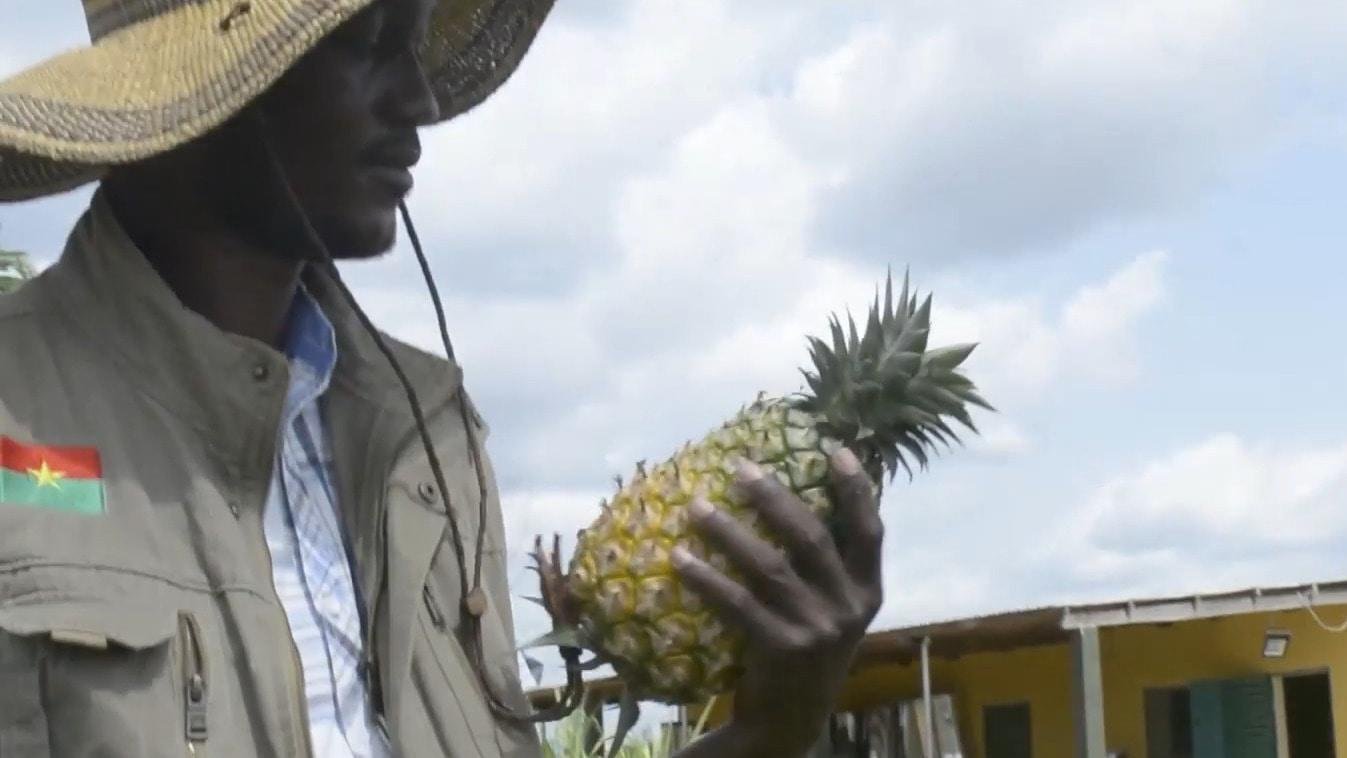
On the red soil of Ouagadougou, a new political narrative is taking shape around an unlikely symbol: the pineapple. The fruit has increasingly appeared alongside the national flag during President Ibrahim Traoré’s public appearances, turning an agricultural product into a powerful image of economic emancipation.
In a landlocked country facing harsh climatic conditions, farming is being presented not merely as a means of survival, but as a cornerstone of national independence and self-reliance.
For decades, Burkina Faso’s agricultural potential was often viewed through the narrow lens of subsistence farming and traditional cash crops. Today, however, pioneering farmers such as Oumarou Compaoré and pineapple grower Kaba Séré are challenging that perception.
By cultivating fruit in an environment considered difficult for such production, they are demonstrating that the Sahel’s intense sunlight can be transformed from a constraint into an agricultural asset. Moreover, pineapple plantations established on military bases as well as on private farms reflect a broader ambition: enabling the population to contribute directly to feeding the nation.
Beyond agriculture, this drive for self-sufficiency echoes the legacy of Thomas Sankara, who placed domestic production at the heart of his vision for genuine independence. The current authorities have revived that principle through a strong patriotic narrative centred on local consumption and national production.
Measures aimed at limiting reliance on imported rice, the expansion of locally produced tomato paste and the promotion of pineapple cultivation are presented as parts of the same strategy. In this context, producing locally is not only an economic choice but also a way of reshaping how citizens perceive foreign and domestic goods.
Furthermore, the campaign for agricultural self-reliance carries a wider political and social dimension. Strengthening food production can help reduce dependence on external supplies while addressing concerns over food security.
In a country already facing significant security challenges, the ability to produce more of what its population consumes is portrayed as essential to maintaining social stability and reinforcing the state’s capacity to respond to national needs.
Ultimately, the pineapple has become more than an agricultural crop in this narrative. It represents an attempt to turn Burkina Faso’s geographical and climatic challenges into opportunities for greater economic independence.
Each new plantation is presented as evidence that the country can make better use of its own land and resources. Through this approach, agriculture becomes both an economic priority and a powerful symbol of a nation seeking to take greater control of its own development.
Joelle.