
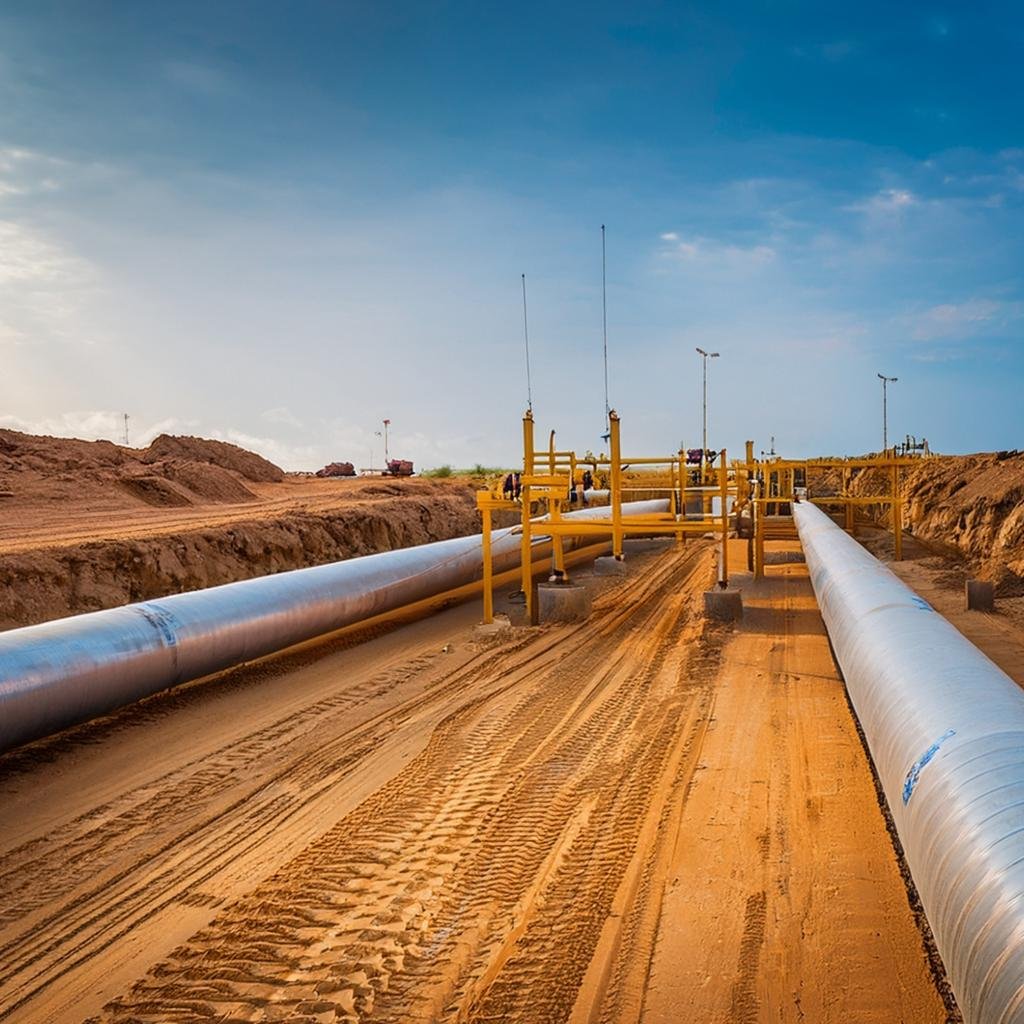
Senegal is seeking nearly $600 million to expand its natural gas transportation network and strengthen electricity supply. The project aims to support power plants, industrial facilities, and the country’s long-term economic development.
According to the Senegal Gas Network (RGS), the public operator responsible for gas transportation infrastructure, the company plans to raise €530 million, equivalent to approximately $595.5 million, from financial partners. Presented during African Energy Week in Cape Town, the programme involves three pipeline sections. Construction is expected to begin in 2027, with operations scheduled for 2029.
Three Pipelines to Supply Power Plants and Industries
First, the Green section will cost €220 million and cover 110 kilometres. With a capacity of 300 million standard cubic feet daily, it will transport surplus gas from the Greater Tortue Ahmeyim (GTA) project towards the other pipelines.
Meanwhile, the Blue section will require €180 million for 100 kilometres of infrastructure. It will supply six power plants and six industrial facilities. The Orange section, costing €130 million, will extend across 45 kilometres to serve six industrial sites and one power plant.
Additionally, the budget includes €25 million in compensation for people affected by construction.
Supporting Energy Security and Industrial Growth
To attract investors, RGS is proposing a renewable 15-year concession and a pricing framework designed to cover investment and operating costs. Its director general, Pape Momar Lo, announced a targeted internal rate of return of 20%.
Furthermore, the programme follows an earlier €275 million project launched in September 2026. This 85-kilometre pipeline will connect the GTA gas hub to a 250-megawatt power plant in Gandon.
Ultimately, the expansion should help Senegal reduce reliance on imported fuels and improve domestic gas use. However, its impact on electricity prices will depend on gas availability, transportation costs, and power plant performance.