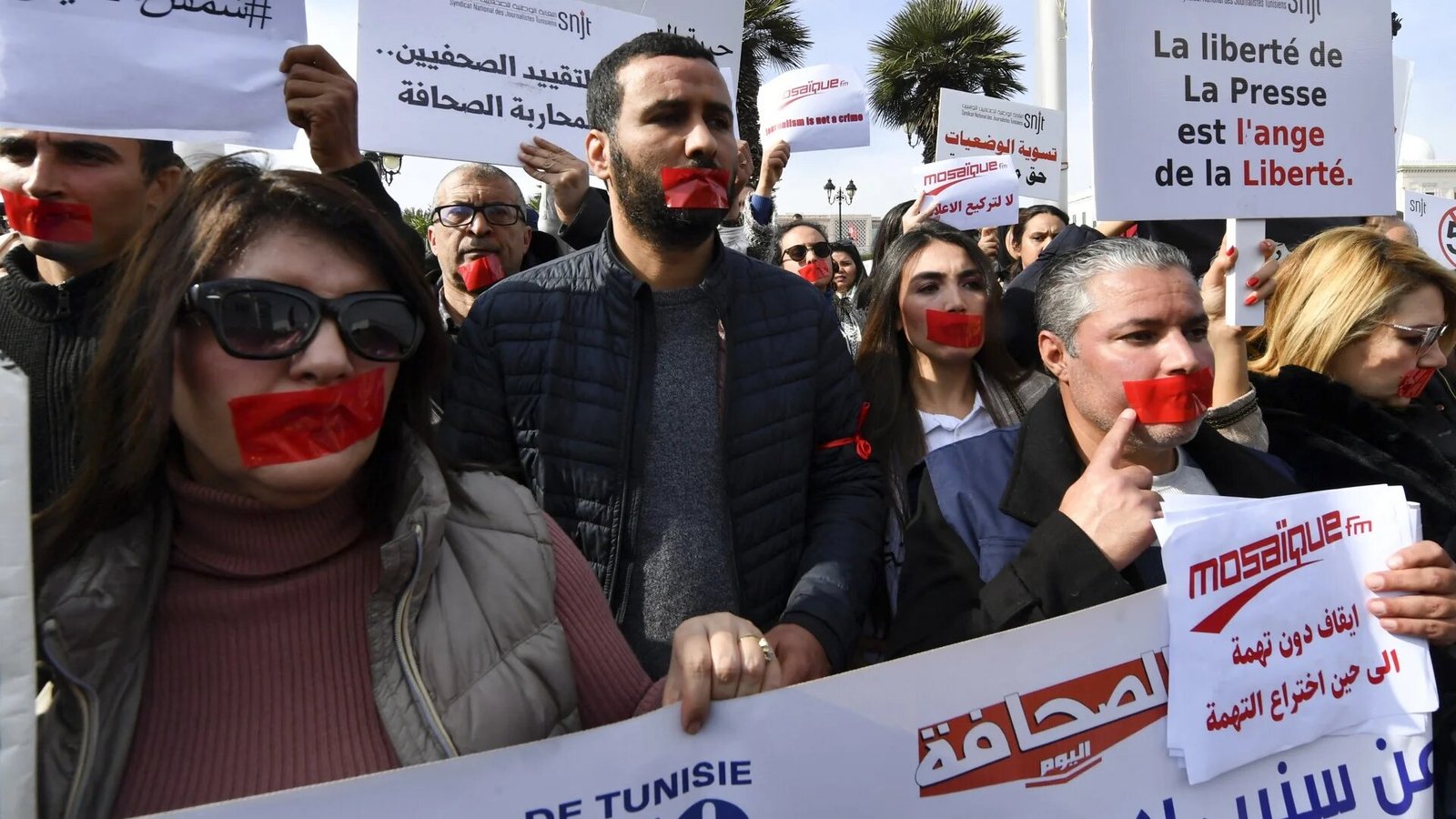
Dozens of journalists gathered in Tunis on Tuesday to protest the detention of Mohamed Yousfi, editor-in-chief of Alqatiba, who was arrested in connection with an investigation into alleged financial offences.
The journalist was detained on Friday as he was heading to a radio interview. Prosecutors accuse him of receiving suspicious funds from abroad and are relying on legislation related to terrorism and illicit enrichment. Yousfi’s lawyer, Hela Ben Salem, however, maintains that no concrete evidence has been presented to establish any wrongdoing.
Beyond the legal proceedings, his health has become another source of concern. The National Union of Tunisian Journalists (SNJT) reported that his condition deteriorated following surgery for appendicitis. According to the union, his lawyers had to stop an interrogation so that he could be given medication after he reportedly experienced intense pain.
Calls for his release
As the case continues to draw attention, Reporters Without Borders (RSF) has called for Yousfi’s immediate release. The organisation argues that the available information does not provide sufficient grounds for keeping him in detention.
At the same time, SNJT President Zied Dabbar has described the case as part of what he sees as a wider crackdown on journalists in Tunisia. He warned that the profession itself could be placed at risk if journalists face imprisonment for even minor professional mistakes.
The controversy comes amid broader concerns over civil liberties in Tunisia. Since President Kais Saied’s political shift in 2021, journalists, lawyers, opposition figures and activists have faced a growing number of legal proceedings. In particular, authorities have used a 2022 law targeting the spread of what is described as “false information”.
Against this backdrop, Yousfi’s detention has become another point of concern for press freedom advocates, who fear that legal pressure on journalists could further restrict independent reporting in Tunisia.