The map of Africa’s economic partnerships is undergoing a remarkable transformation. Long dominated by traditional circuits of international financing, investments on the continent are now opening up to new actors, with the growing presence of Gulf powers.
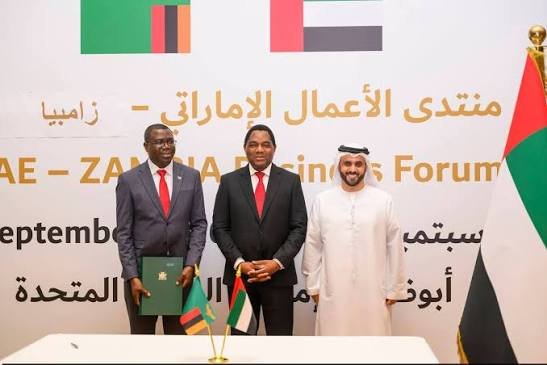
In Zambia, the United Arab Emirates’ involvement in the Mopani copper mines provides a concrete illustration of this realignment, an operation with economic, diplomatic, and political dimensions.
Through International Resources Holding (IRH), Abu Dhabi is committing up to $1.1 billion in Mopani Copper Mines, with a 51% stake, while Zambia’s state-owned company ZCCM-IH retains 49% of the capital.
This operation, concluded in 2024, reflects a desire to mobilize international capital around a strategic mining asset, with Zambian participation maintained at the heart of the shareholding.
This choice deserves particular attention. Zambia is asserting its ability to diversify its partners and build economic relationships with powers that possess financial resources, commercial networks, and international industrial ambition.
This openness expands African states’ room for negotiation with traditional economic actors and fosters a diplomacy based on the pursuit of mutual interests.
The cooperation between Lusaka and Abu Dhabi thus carries a strong political dimension.
It illustrates another path in mobilizing capital: that of partnership, equity participation, and direct financing of productive capacities.
This orientation can help reduce historical dependencies when agreements guarantee African countries a genuine place in governance and wealth creation.
Copper gives this alliance its full significance. Indispensable to electrical grids, digital infrastructure, and new technologies, it represents a major lever of the global economy. Zambia therefore possesses a strategic resource whose development can strengthen its weight in international trade.
Mopani’s ambition, with a target of 300,000 tonnes of finished copper per year by 2029, opens prospects for employment, local businesses, and national revenues. IRH and ZCCM-IH reaffirmed their joint commitment in October 2026.
The true success of this cooperation will be measured by its benefits for the Zambian population. Local processing, skills transfer, and national control over strategic choices must remain at the center of this dynamic.
Through Mopani, Zambia is exploring an economic diplomacy of diversification—a trajectory that reminds us that the future of African resources also depends on the freedom of states to choose their partners and negotiate the conditions of their prosperity.