
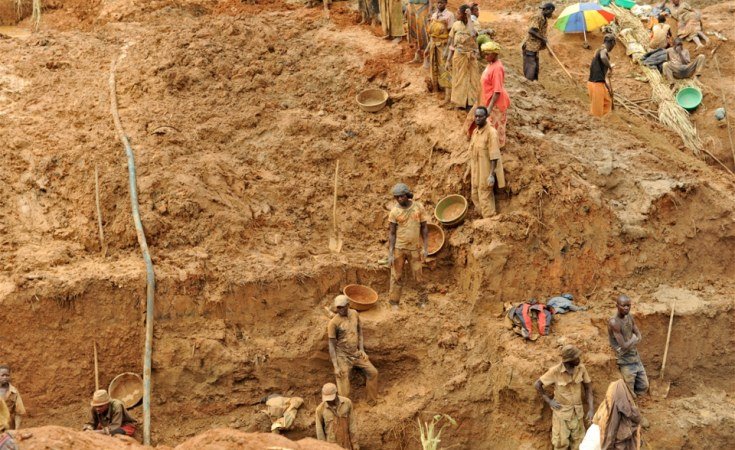
The Democratic Republic of Congo is launching a major effort to gain greater control over information about its underground resources.
By the end of 2026, the government plans to have a national geological database in operation, bringing together newly collected information, digital archives and detailed maps of the country’s mineral potential.
To achieve this objective, Kinshasa has increased the use of aerial surveys and large-scale geological mapping. In January, the government awarded a $180 million contract to Spanish company Excalibur to conduct surveys across more than 700,000 square kilometers. In parallel, cooperation has been established with several international organizations, including France’s BRGM, South Africa’s Council for Geoscience and other foreign companies.
The initiative is particularly significant because much of the DRC’s territory has yet to be thoroughly explored. Despite being one of the world’s major sources of copper, cobalt, lithium, tantalum and gold, systematic geological exploration covers only around one-fifth of the country, according to the National Geological Service. At the same time, interest from investors is growing: exploration spending reached a record $130.7 million in 2024.
Information as a Strategic Asset
Once the database is established, the government intends to regulate how geological information is accessed. General data would remain available without charge, while information considered more sensitive could be sold to users. The money generated could then be reinvested in future geological surveys and exploration projects.
Raoul Wazenga Vitima, head of the National Geological Service, considers the information produced through these programs to be a strategic asset of the Congolese state.
Yet this policy has raised questions about openness. Mining powers such as Australia, Canada and the United Kingdom generally make large amounts of geological information publicly accessible. Consequently, some stakeholders in the Congolese mining sector believe Kinshasa should adopt a more open model, arguing that wider access could attract investors, stimulate research and increase competition.
The government, however, sees control over the data as a way to strengthen its negotiating position. Having a clearer picture of the country’s mineral potential could allow authorities to negotiate more effectively with companies and encourage investment from a broader range of financial partners. More broadly, those who control the most accurate geological information can have considerable influence over which areas receive attention from mining companies.
Geology at the Centre of Global Competition
The issue also extends beyond the mining sector itself. The DRC is increasingly caught up in the rivalry between Washington and Beijing over access to critical minerals. Despite this competition, Congolese authorities maintain that they will treat American, Chinese and other foreign partners according to the same rules.
Cobalt illustrates the importance of this position. With roughly six million tonnes of reserves, the DRC holds more than half of the world’s known cobalt resources, according to the US Geological Survey. Furthermore, Kinshasa demonstrated its ability to influence the international market in 2025 by temporarily halting cobalt exports and later introducing quotas. The measures helped reduce the global surplus and contributed to higher prices.
In this context, controlling geological information represents a new stage in the country’s mining strategy. The government is no longer focusing solely on who extracts its minerals or how they are exported. Instead, it is seeking to control the knowledge that determines where future deposits could be discovered and which projects might eventually be developed.
Ultimately, Kinshasa wants geological knowledge to become a source of both economic value and national influence. However, the success of this strategy will depend on more than the creation of a sophisticated database. Transparency, fair access and clear rules for using the information will be essential if the system is to attract investment while protecting the country’s interests.