UAE investments in African agriculture are no longer limited to land purchases. They now target irrigation, seeds, and local processing, with a stated objective: reducing the continent’s food dependence. The 2026 figures illustrate this rise in power.
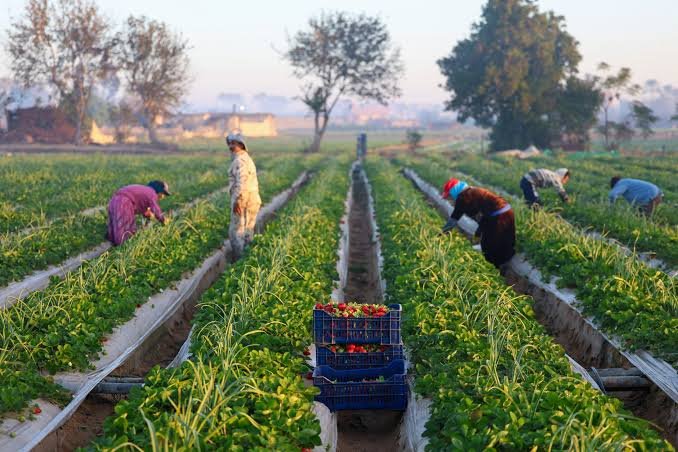
In Mauritania, the Aftout/Rosso project embodies this integrated approach. Elite Agro Holding, the Arab Authority for Agricultural Investment and Development (AAAID), and Saba Agrima are injecting 440 million Emirati dirhams (around $120 million) to develop 8,900 irrigated hectares.
Expected production reaches 244,000 tonnes of agricultural products, intended for the Mauritanian market and neighboring countries.
The project is expected to create more than 4,000 direct jobs, a majority benefiting rural women, and 6,000 indirect jobs.
Large-scale irrigation thus transforms arid lands into local productive capacities, without exporting all production to the Gulf.
In Côte d’Ivoire, the logic is similar but adapted to rice. The country still imports 55% of its consumption, estimated at 2.9 million tonnes, while less than 900,000 hectares are exploited out of more than 2 million available.
In April 2026, the Ministry of Agriculture received a delegation from Resources Investment LLC to develop the local rice sector.
The issue is not only financial: it is about financing the expansion of national production and reducing an import bill that weighs on foreign exchange reserves.
Local processing remains the weak link in many projects. In Kenya, the CEPA agreement signed with the UAE in January 2025 aims precisely to enable producers to sell processed products rather than raw materials.
The Galana Kulalu project, with Al Dahra’s declared interest in 180,000 irrigated acres, could generate import savings estimated at between 400 and 500 billion Kenyan shillings per year once fully operational.
But experience shows that without storage, packaging, and processing infrastructure, irrigation alone is not enough to create local value.
The UAE does not hide its strategic interest: securing diversified supply chains while projecting its economic influence.
Emirati Minister of Foreign Trade Thani bin Ahmed Al Zeyoudi presents these projects as cross-border cooperation beneficial to both parties.
The reality is more nuanced: while irrigation and seeds improve African yields, dependence on foreign capital and technology remains.
African food sovereignty cannot be decreed with external investments; it is built by negotiating real skills transfers and processing on African soil.