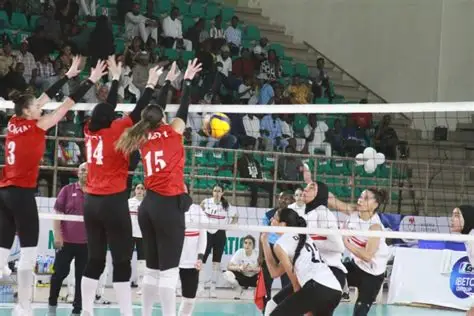
African women’s volleyball is entering a new era. More countries are joining continental competitions, emerging teams are challenging the traditional powerhouses, and the balance of power is becoming increasingly unpredictable. The 2026 African Women’s Volleyball Championship in Nairobi was a clear illustration of this changing landscape.
Egypt emerged as the champions, defeating hosts Kenya 3–0 in the final, with scores of 25–22, 25–15 and 25–15. The victory came against the defending champions, who have won the African title ten times.
Egypt’s dominance was clear throughout the tournament. The team won all seven of its matches without dropping a single set, recording 21 sets won. This fourth continental title, following victories in 1976, 1989 and 2003, also secured Egypt’s qualification for the 2027 FIVB Women’s Volleyball World Championship and puts the team on course for the 2028 Olympic Games in Los Angeles.
For Mariam Metwally, named the tournament’s MVP, the victory is also a step toward a much bigger ambition.
“My only dream is to reach the Olympic Games. I am very happy to have been named MVP and, for the first time in my career, best outside hitter. And above all, yes, we are African champions!” she said.
A wider and more competitive field
Beyond Egypt’s victory, the Nairobi tournament highlighted a broader transformation in African women’s volleyball.
Fifteen national teams took part in the competition, reflecting the growing number of federations investing in women’s volleyball. More countries are now developing teams capable of competing at continental level, making the championship increasingly competitive.
The traditional hierarchy is also beginning to change.
Kenya and Cameroon remain among Africa’s leading volleyball nations. Kenya has won ten continental titles, while Cameroon dominated three consecutive editions in 2017, 2019 and 2021.
But the gap is narrowing. Egypt has now reclaimed the title, Rwanda reached the semi-finals, while Algeria, Tunisia, Ghana and Uganda also demonstrated their growing potential.
For Yende Tiadjoué Lavoisier, coach of the Cameroon women’s national team, this development is only the beginning. He believes women’s volleyball is genuinely moving forward and expects the next edition to produce even more surprises.
Players are gaining more experience
Another key factor behind this progress is the growing experience of African players.
The leading national teams increasingly include athletes who have competed in professional clubs outside the continent. These players benefit from stronger leagues, professional training environments and regular exposure to high-level competition.
That experience is then brought back to the national teams, helping them improve their performances and compete more effectively.
As a result, matches are becoming tighter, coaches are facing greater tactical challenges, and even the traditional powerhouses can no longer assume that victory is guaranteed.
At the same time, progress is being made beyond the court.
Coach development, stronger domestic leagues, the work of the different CAVB zones and better-structured national federations are all contributing to the sport’s development.
Technology is also becoming increasingly important. At the Nairobi championship, video challenges, live statistics and electronic score sheets helped modernize the competition.
According to Bouchra Hajij, President of the African Volleyball Confederation, this progress is the result of collective efforts. She praised the unity within the volleyball community and its shared objective of raising the standard of the sport across the continent.
The real challenge lies ahead
The Nairobi championship has therefore sent a clear message: African women’s volleyball is becoming broader, more competitive and better organized.
But the biggest test will come on the international stage, where African teams will have to measure themselves against the world’s best.
Egypt, Kenya and Cameroon will get that opportunity at the 2027 FIVB Women’s Volleyball World Championship, while Egypt will also have its sights set on the 2028 Olympic Games in Los Angeles.
Ultimately, the success of African women’s volleyball will not be measured only by the level of competition within Africa. The real objective will be to narrow the gap with the world’s leading volleyball nations.